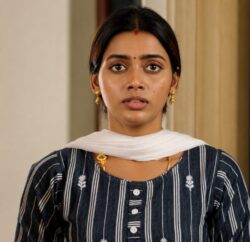
1. Ananda Raj, a.k.a. Happy Raj (G.V. Prakash), is ridiculed by everyone in his village because of his father (George Maryan). No one likes him for this reason, so he moves to Bangalore and lands a corporate job. There, he grows close to Kavya (Sri Gouri Priya), and they eventually fall in love. However, problems arise due to the cultural differences between their families.
Plus Points:
The film explores the father-son bond in a neat manner. Though the protagonist is constantly ridiculed because of his father, he never speaks a hurtful word against him. The dialogues toward the end between George Maryan and G.V. Prakash Kumar, describing this aspect, are well-written and effectively presented. George Maryan left a solid impact with his performance, which is sure to draw whistles from the crowd.
The second half of the film offers a decent mix of fun and emotions. From the moment the heroine’s family moves to the hero’s village, things get engaging. The episodes revolving around the “sorry” theme are decently entertaining.
G.V. Prakash Kumar did a really good job as Happy Raj. As someone who suffers because of his father and struggles to keep up with his in-laws, the music director-turned-actor displays good variations. Sri Gouri Priya is one of the most promising finds in South cinema. She has the potential to become a star, as she is both charming and equally good at acting. Abbas makes his presence felt.
Minus Points:
The first half has plenty of boring scenes, and the comedy moments don’t quite hit the mark. Things aren’t much exciting here, and the film moves ahead in an underwhelming manner without any big moments till the halfway mark. The songs aren’t catchy either.
There are a couple of emotional tracks in the film. While the one involving the hero and his father clicks, the other one related to Abbas’ character feels unconvincing and is also a bit contradictory to what the film showcases.
Also, the conflict between the lead pair isn’t shown effectively and lacks clarity. Had these two elements been handled better, the film could have been more engaging. The editing is below par, and the film feels dragged.
Technical Aspects:
Justin Prabhakaran’s music is ordinary, and the Telugu translation could have been better. Madhan Christopher’s cinematography is fine, and the production values are neat, though some VFX work feels patchy.
Direction by Maria Raja Elanchezian is just okay. While some moments are handled well, others needed more refinement. The attempt to deliver a wholesome family entertainer is evident, but the film works only in bits and pieces.
Verdict:
On the whole, Happy Raj is a family entertainer that works in parts, with a comparatively better second half. GV Prakash Kumar, Sri Gouri Priya, and George Maryan deliver very good performances, and the second half offers some good moments. However, the not-so-effective first half, unconvincing segments, and dragged moments prevent it from fully working.
2. Dignity. They say there is no unique experience in this world. What one goes through might be personal, but it is not something no one else has experienced. That’s why it is surprising that empathy is sparse in this world. Of course, empathy, like any other emotion, takes time to cultivate. This timing is crucial because empathy can be perceived as misplaced, misunderstood, or mocked if it isn’t rooted in understanding. The need to accord this dignity not just to those around us but also to the self is one of the more pronounced takeaways of debut director Maria Raja Elanchezian’s Happy Raj. However, this journey takes one too many detours, has one too many contradictions, and finally ends up taking the flavor-du-jour route of ‘It’s all about loving your father.’
Happy Raj (GV Prakash Kumar), aka Anandraj, wants to be a happy-go-lucky youngster, but fate has handed him a raw deal, and he feels neither happy nor lucky thanks to his father Kaathamuthu (A terrific George Maryan). Happy’s father is the subject of immense ridicule for his looks and stature, and is called ‘Kudhirai Muttai’ (Horse’s egg). This tag becomes his identity, and Happy is ostracised for it; this neglect extends to his love life, where women stay away from him, not wanting to be the daughter-in-law of Kudhirai Muttai. Trying to start afresh, Happy moves to Bengaluru and meets Kavya (Sri Gouri Priya), his senior at an IT company. When the romance becomes serious, and the idea of marriage is broached, the film becomes Meet the Parents and Meet the Fockers rolled into one, with a liberal dose of culture shock, an urban vs. rural divide, class hierarchy, and, of course, the need for dignity.
Coming to the detours that derail the film for a while, Happy Raj’s major drawback is its incessant need to wring out a romcom from a stirring emotional drama. While it is commendable that the meet-cute romance between Happy and Kavya is wrapped up very quickly, the film needed to be a little more coherent without resorting to mindless one-liners that might evoke a chuckle but are a distraction. It wanted to go for the Yaaradi Nee Mohini vibe of a stuttering newcomer falling in love with a confident mentor, but it takes the comic route to get there. While this detour is definitely interesting, the film doesn’t go all out with the humour. This means the comedy weighs down the romance, and the humour gets watered down by the love. But then again, the entire first half with its various set-pieces involving Happy and Bhaskar (Madurai Muthu), Happy and two North Indian go-getters, Kaathamuthu and Kavya’s father Rajiv (Abbas), and even Happy and Kavya blow hot and cold because it acts as a setup for the entire second half.
All the genuine fun moments and the compelling comedy are packed one after another in the second half of Happy Raj, and Maria definitely salvages a film that could have crashlanded. He is heavily bolstered by the wonderful music of Justin Prabhakaran and a terrific George Maryan, who shines high in his best role since Kaithi. In fact, it feels nice to have an actor like George get wonderfully written scenes that make it clear that the film might be titled Happy Raj, but the protagonist is definitely Kaathamuthu. Full points to GV Prakash for sidestepping when the film needs him to. Maria, who goes for easy laughs in the first half, puts in a lot more concerted effort in the second and rewards us with a narrative that does enough to elevate the characters who are generally treated with disdain. While the ‘North Indian’ stereotype is milked for humour, there is an undercurrent of dignity accorded to their grit and persistence. Even as Kaathamuthu’s gait, behaviour, and skin colour are often invoked to evoke various emotions, the film never treats him badly. Here, the character stands tall despite whatever is thrown at him in the name of narrative convenience. George plays the character with just the right mix of restraint and flamboyance, and the very fact that Kaathamuthu is a hero in his own eyes is such a refreshing turn of events. Even if many characters ridicule him, Kaathamuthu never feels defeated, and the film doesn’t paint him as a naive villager waiting for a saviour to uplift him from his predicament.
At times, this underlying layer of respect does get hidden when the humour elements overstay their welcome. This also means that some neat little touches don’t get their due. For instance, Happy’s mother (Geetha Kailasam), portrayed as a simple villager, undergoes a major makeover when she visits her son in Bengaluru. Interestingly, when she returns home, she doesn’t shed the makeover and reverts to her demure self. Her choice of sarees, her hairstyle, her makeup… everything changes, and not a word is spoken about it. It shows the kind of house Happy grew up in, and the kind of father Kaathamuthu is. But these flourishes aren’t half as pronounced as the never-ending ego clashes between Rajiv and Kaathamuthu. Again, naming Abbas as Rajiv and his wife as Reena is a funny ode to Minnale, but it doesn’t go anywhere. And again, it all comes down to George, who shoulders the entire film and lends it immense respect and dignity. There are a few monologues, though cramped into the narrative, that elevate the film simply because they come from a place of truth and honesty.
While the film oscillates between could-have-beens and should-have-beens, Happy Raj ends up a better family drama than a good romcom. Of course, there is a fair share of manipulation. Still, then, when Kaathamuthu makes you introspect with a throwaway line about simple biology. George Maryan reiterates that an actor’s talent needs the right scaffolding; we overlook this simply because they absorb taunts, mockery, and verbal assaults, yet never surrender their dignity.
3. G. V. Prakash Kumar is one of the rare multitalented artists in India, working as both a music director and a lead actor. He has composed music for about 100 films and acted in about 25 as a lead actor. After releasing four films each in 2024 and 2025, he has come up with, Happy Raj, his first theatrical release as lead actor in 2026. Kadhal Desam/Prema Desam fame Abbas made a comeback to films with a crucial role in ‘Happy Raj’. Sri Gouri Priya, played the lead actress role and George Maryan played a very important role in the film. After promoting well in both Tamil and Telugu, the makers released the film in theatres today. Did G. V. Prakash Kumar, score a hit at the box office? How did, Abbas, do in his comeback film? How did the debutant director, Maria Raja Elanchezian, do in his first film? Let’s figure it out with a detailed analysis.
Anandh Raj Aka Happy(G. V. Prakash Kumar), is a young graduate who aims to let some girl fall in love with him. But, every girl, he approaches in his village, rejects him by saying ‘You are a good guy, have a very innocent face as you look good as well. However, I can’t fall in love with you and marry you because of your father(George Maryan). Frustrated with all the rejected proposals, he decides to move to a city and test his luck. He moves to the city and falls in love with his team leader, Kavya(Sri Gouri Priya), at the office. She accepts his proposal and introduces him to her father(Abbas). Impressed by Anandh’s skills as an app developer, Kavya’s father agrees to get her married to Anandh and decides to announce it to his friends and family during his 15th marriage anniversary. What happens when Kavya’s father announces the marriage alliance at the party? Why did the girls in the village reject Anandh because of his father? Forms the rest of the story.
G. V. Prakash Kumar did well in emotional episodes in the second half but in most parts of the film, there’s not much he did apart from getting ‘irritated’ and ‘frustrated’. Yesteryear heartthrob, Abbas, played a crucial role in the film. He is still looking very handsome and charming. He did well in the second half but in the first half, he looked out of place.
George Maryan in a tailor-made role impressed yet again with his performance. As a loving father, he was too good, especially in the pre-climax and climax episodes. Sri Gouri Priya in the lead actress role looked good and delivered a decent performance along with dancing well in a couple of sequences. Geetha Kailasam in the role of a mother delivered an adequate performance. Adhirchi Arun and Madurai Muthu, tried to generate comedy but most of the episodes on them were over the top. Especially, a few dialogues in the introduction sequence of Adhirchi Arun, are of very poor taste. Premgi Amaren appeared in a sequence and tried to make the audience laugh but it did not work out.
Justin Prabhakaran scored a good song in the second half but apart from that, his work in the film is strictly below par. His background score for the first half should have been much better. Selva RK, with his editing should have done a better job. At least fifteen to twenty minutes of the film should have been easily edited to make it engaging. Madhan Christopher’s cinematography is standard. There’s not much to talk about his work. However, he captured the picturesque locales of rural Tamilnadu well. Let’s discuss about the writer and the director, Maria Raja Elanchezian’s, work in detail in the analysis section.
‘Kuntodu’, ‘Chevitodu’, ‘Moogodu’, ‘Pottodu’, etc., we must have heard people address the disabled with these names quite often, right? Especially, in villages and small towns it is a common practice, isn’t it? But, did we ever think about the trauma and the inferiority complex it causes to the disabled people and their families? The debutant director and writer, Maria Raja Elanchezian, took this interesting and socially relevant point and tried to come up with a romantic comedy film. He packaged it with romance, comedy and emotional drama, in typical, Pradeep Ranganathan, style films. The director in the past worked as an assistant director for Pradeep Ranganathan’s directorials, Comali and Love Today. So, the influence is obvious and it worked to some extent as well but for some reason, the director dragged almost every episode in the film with many repetitive sequences. The basic plot is very relatable and the film has a few good comedy portions as well, especially in the second half but because of the repetitive sequences, excessive length and loud first half, the film eventually ended up just about ok.
The best part of the film is when the proceedings shift to the village in the second half. During this part, the film offers a few genuinely laugh-out-loud moments, a few feel-good moments, a couple of emotional sequences and a good song. Especially, the back story of the hero’s father and the emotional sequence between the hero and his father in the pre-climax, worked in favour of the film. A few moments during this part were quite relatable and were narrated in a gripping manner. Even in the first half, there were a couple of episodes in which comedy worked to an extent.
But, apart from the aforementioned positives, the rest of the film tests patience with quite a few repetitive and illogical sequences. Barring a couple of moments, the entire first half is too loud and gives an outdated feeling. Better writing and execution during the first half, should have done a world of good to the film. At a time when most of the filmmakers across the country are trying to make films that can cater to audiences from all around the country, it is surprising to see a young debutant director using full fledged track on ‘North Indians and their traits’, to generate comedy. This entire track was written and executed in poor taste and it should have been avoided. It is fine to an extent if a writer and director leave logic to generate comedy but it is again surprising to see the director not bothered about the logic in the crucial climax pay-off sequence between the father characters of the hero and the heroine. Also, the background score at most places in the first half is too loud and irritating after a point. At quite a few places throughout the film, the score dominated the dubbing of the artists and made it difficult to even hear and understand the dialogues.
Overall, Happy Raj, has an interesting core point and it offers a few engaging moments but the loud and outdated first half along with many repetitive sequences, worked against it. You may watch the film when it releases on OTT but visit a theatre to watch it, only if you are fine to sit through a two-and-a-half-hour film to watch a few good moments here and there.